A campfire or a chatbot? Which matters more to the future of work?
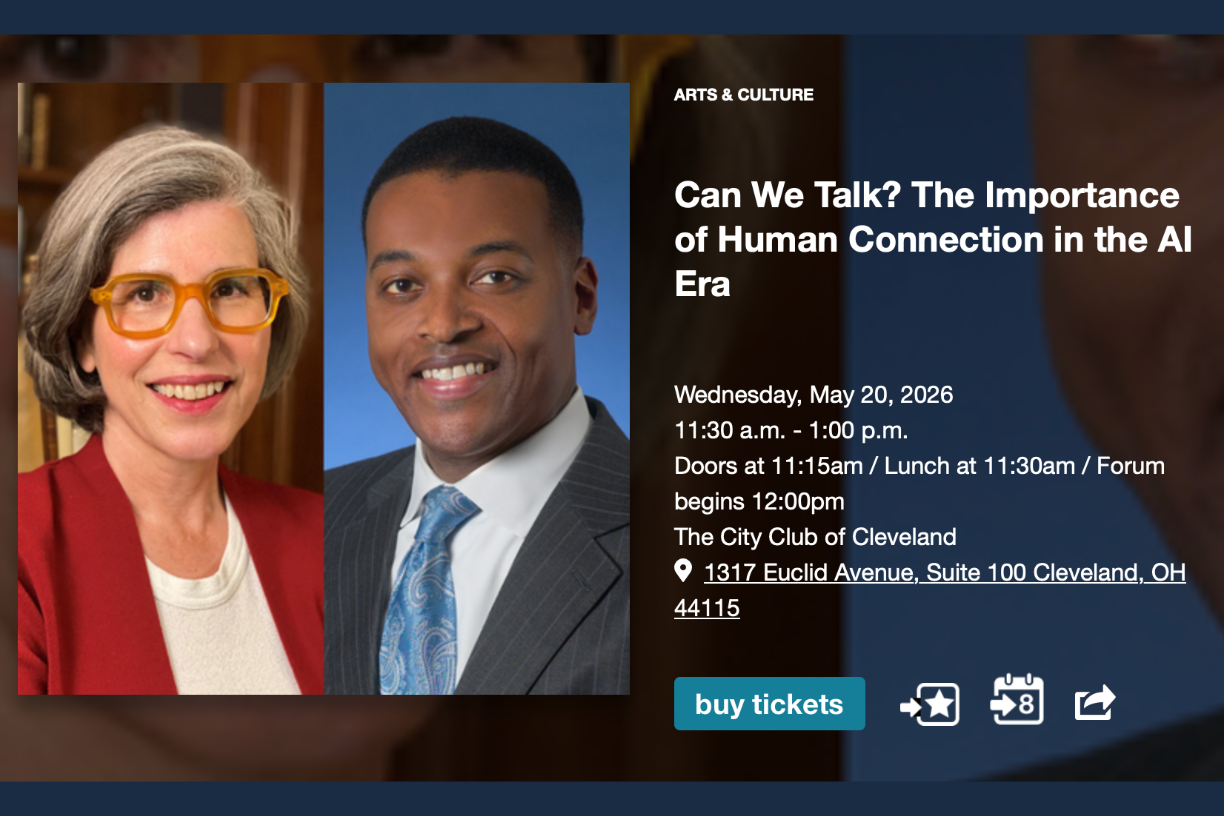
That’s the question I posed to an audience at The City Club of Cleveland.
The chatbot is certainly faster. It can draft a memo in seconds, summarize a meeting and produce language faster than any human being can read it.
The campfire is older. Long before offices, org charts, Outlook or Zoom, people gathered around fire. We shared warnings and memories, grief and humor, values and knowledge. We learned who could be trusted. We remembered the past and imagined the future. Most importantly, we told stories that helped us think together.
The chatbot produces language. The campfire produced meaning. Human beings didn't become powerful because we were the fastest or strongest species. We became powerful because we could connect, cooperate, and make meaning together. But that distinctive human advantage is under strain.
We have more ways to reach one another than any generation in history, yet many of us feel farther apart than ever. We’re reachable all day and harder to reach in the moments that matter. It’s like we’re starving at a buffet.
We’re lonely, we’re unhappy, and we don’t trust one another. Our communities are shrinking. Our friends are dwindling. An astonishing 54% of Americans feel isolated and lonely. The United States has one of the worst trust ratings in the world: 53% of Americans rated their fellow citizens’ morals and ethics as bad. And we bring that fracture to work. It follows us into meetings, teams and decisions. It appears when someone weighs the cost of honesty and decides to stay silent.
That disconnection matters because it undermines the very foundation of productive work. Human enterprise flourished for one reason: because we learned how to cooperate at scale. Every major human achievement was a group project before it became a cure, a technology, or a rocket launch.
That has always been the human advantage: not just what one mind can produce, but what many minds can build together. AI doesn't override this advantage, it makes it even more important. AI can code, summarize, analyze, translate, and generate answers at extraordinary speed. But speed is not wisdom.
More answers do not mean better judgment. More words don't mean better reasoning. If we’re not careful, we won’t just outsource tasks, we’ll outsource thinking. And the best thinking is rarely accomplished alone. It happens between people. That's what matters most: how a team works together.
The five skills every team needs now
At Reflection Point, we’ve spent nearly two decades studying this. In real conversations, with real teams, across industries, roles, and tenures. And again and again, we’ve seen five distinctly human skills that help teams work better together. Five skills that we need now more than ever.
- Listening with humility. Listening well, with genuine humility, enhances our capacity for innovation and drives collaboration.
- Asking good and curious questions. Authentic questions surface other people’s hidden insights and unleash new ideas.
- Challenging strongly held assumptions. Suspending our “known truths” opens us to other points of view and expands our mental models.
- Disagreeing with respect and without retribution. Positive disagreement strengthens learning when it is grounded in psychological safety, trust and mutual regard.
- Widening the circle of empathy. Deepening relationships expands our understanding and strengthens inclusion and belonging.
These skills sound simple. But they are very, very hard. Listening requires us to stay open long enough to learn something new. Disagreement tests whether a team can handle the truth. Silence can look like alignment. Too often, it means people have learned to keep the truth to themselves.
These skills also require practice. No great sports team waits until game day to practice passing, timing and trust. Yet organizations routinely ask business teams to navigate conflict, uncertainty and change without building these skills first.
When teams practice these skills, they do more than communicate better. They think better. They develop collective intelligence: the ability to learn, adapt and innovate well beyond what any one person could do alone.
Yes, intelligent machines can help us move through and process more information than ever before. But meaning is the stuff of people. And it all starts with these five intrinsically human skills that we need to build and protect at all costs.
Stories as practice
Reflection Point has found a remarkable way to build these skills: discussing short stories with a facilitator. A story lets people see themselves and their hardest challenges from a different angle. No one in the room is the expert. No one is the boss. That gives people room to listen, question, disagree and reconsider what they thought they knew. Room to see themselves and one another more clearly.
What can that new understanding and perspective change? At one manufacturing company, the answer showed up in more productivity and on time delivery.
When I asked one of the team members to tell me why discussing stories worked, he quoted John Steinbeck: “You can’t hate a man once you know him. And now that we know each other there's no problem we can't solve together.”
Time and again we see the power of stories to change how people think, act, and work together. Teams don’t just talk about literature. They talk about trust, conflict, change and the kind of company they want to build. As one worker said, “This story isn’t about work. But then again, it’s all about work.”
Keeping the campfire alive
Stories bring us back to the campfire. Not as a place but as a practice. A way of gathering close enough to hear one another, slow down to reflect together and remember that every person around us carries the wisdom of life experience we don’t see at first glance.
Stories are the original human technology. They taught us how to survive together. And now, in a world of intelligent machines, they can help us remember how to stay human together.
The chatbot isn't going anywhere. It will keep getting faster and better. The volume of language it generates will keep rising. The buffet will keep getting bigger. But speed will not tell us what kind of people to become. Language will not make us brave. Generated answers will not make us wise.
For that, we need each other. And our most important job is to be sure that our quest for speed, efficiency and the newest technology doesn't extinguish the campfire.